Answered: he amount of the outstanding checks is included on the bank reconciliation as an Select one: A addition to the balance per bank statement B. addition to the

While accounting software apps that offer bank connectivity can expedite the reconciliation process, they should not replace performing your own monthly bank reconciliation. After all adjustments are made, the balance on a bank reconciliation statement should equal the ending balance of the bank account. Performing a regular bank reconciliation enables a business to locate any missing funds, prevent Where To Mail Tax Return fraud, and verify the cash flow on its balance sheet. Discrepancies between a bank statement and book balance are commonplace, but businesses must account for each one and adjust the general ledger accordingly. The key is ensuring the person responsible understands both the bank statement and your company’s financial records.

It’s a report that matches your company’s cash book balance to your bank statement balance. If an outstanding check from the previous month did not clear the bank account in the current month, the check will remain on the list of outstanding checks. If you’re wondering how to calculate outstanding checks in bank reconciliation, the process is simple. List and subtract these outstanding checks from the bank’s ending balance during reconciliation to keep your financials accurate.

The example below shows how these adjustments appear in a simplified bank reconciliation statement. These adjustments explain why your book and bank balances may differ and are essential for ensuring both records match after reconciliation. Once these components are reviewed and adjusted, both records statement of cash flows direct method should align to reflect your company’s true cash position. Bank reconciliation gives you a clear picture of your company’s finances and helps you stay in control of cash flow. Together, these processes help ensure accuracy across all your company’s financial records, not just those related to cash.

  • Use tools like the ROI calculator alongside reconciliation data.
  • Many businesses use an Excel template for easy customization.
  • Outstanding checks play a key role in the reconciliation process.
  • Bank debit memos indicate that the bank has decreased the balance in a company’s checking account.
  • The party receiving the check may not have deposited it immediately.

Get Started with Invoice Fly’s Software

Outstanding checks are checks written by a company, but the checks have not cleared the bank account. Frequent reconciliation helps you catch outstanding checks early and act before they become stale. Any check listed in your register that doesn’t appear on the bank statement is likely outstanding. Bank reconciliation ensures your business’s internal financial records accurately reflect your cash flow. You’ll compare the two lists and check a box next to each QuickBooks transaction that also shows up on your bank statement. An accountant can take care of bank reconciliation on your behalf.

  • For the past 52 years, Harold Averkamp (CPA, MBA) hasworked as an accounting supervisor, manager, consultant, university instructor, and innovator in teaching accounting online.
  • Understanding what outstanding checks are in bank reconciliation is key to keeping your finances on track.
  • Adjustment COn June 28, the bank statement showed that Lee Corp’s checking account balance was decreased by $110 for a check that Lee Corp had deposited in its checking account.
  • A bookkeeper or accountant usually performs the reconciliation, while an owner or manager reviews it.
  • This means the bank has made an adjustment to your balance that has not yet been recorded in your general ledger (G/L).

How often should I reconcile my accounts?

Assume that a new company opens a checking account at Community Bank with a deposit of $10,000. When a company writes a check, the company’s general ledger Cash account is credited (and another account is debited) using the date of the check. For simplicity, our examples and discussion assume that the company has only one checking account with one general ledger account entitled Cash. For instance, a company will have one Cash account for its main checking account, a second Cash account for its payroll checking account, and so on. The bank reconciliation also provides a way to detect potential errors in the bank’s records. The first step in preparing the bank reconciliation is to adjust the bank balance for any timing differences and/or the rare bank error.

For the past 52 years, Harold Averkamp (CPA, MBA) hasworked as an accounting supervisor, manager, consultant, university instructor, and innovator in teaching accounting online. Get your free guide, business plan template, and cash flow forecast template to help you run your business and achieve your goals. Understanding how they work—and how to manage them—helps to make sure your financial statements reflect your true cash position.

Next, we will prepare a bank reconciliation for a hypothetical company by using transactions that are commonly encountered. Bank service chargeGenerally, a company does not record the bank’s monthly service charge until the company reviews the monthly bank statement. NSF check is a check issued by a company, but the bank did not pay/honor the check because the company’s bank balance was less than the amount of the check. ACH, EFT, Zelle transfers, and wire transfers can indicate additions to or subtractions from a company’s bank account without the company preparing a deposit slip or writing a check. Uncollected funds occur when a company deposits a check into its bank account, but the check is drawn on an account at a different bank. If the checks were to be paid, the checking account balance would become a negative amount.

Bank debit and credit memos

In other words, Adjusted balance per BANK must equal Adjusted balance per BOOKS. The adjustment for the service charge is subtracted from the unadjusted balance per BOOKS. In early June, SmithCo sees that the bank deducted $25 for the May service charge. The adjustment will be a deduction from the unadjusted balance per BANK.

Accounting for Cash at the Company

But until the recipient deposits or cashes that check, it’s considered “outstanding.” Outstanding checks are payments you’ve issued but haven’t yet cleared your bank account. In this article, we’ll go through outstanding checks, why they matter, how to identify and record them, and the best practices for managing them efficiently.

All bank and credit card accounts should be reconciled regularly to maintain accurate financial records. Journal entries record items that affect your book balance, such as bank fees, NSF checks, or interest earned. This is your true cash balance for financial accounting purposes. Compare each transaction on your bank statement to your cash book.

What is invoice reconciliation? A step-by-step guide

Checks are a company’s written orders to its bank to pay an amount from the company’s checking account. With the true cash balance reported in the Cash account, the company could prevent overdrawing its checking account or reporting the incorrect amount of cash on its balance sheet. The purpose of the bank reconciliation is to be certain that the company’s general ledger Cash account is complete and accurate. Determine the outstanding checks by comparing the check numbers that have cleared the bank with the check numbers issued by the company.

How Often Should You Reconcile Your Bank Account?

Of course, you can perform bank reconciliation as often as you like. A single 30-day period should give you a manageable number of transactions to compare between accounts. If someone has withdrawn funds without your knowledge or consent, bank reconciliation will clue you in. At the end of the process, both your bank account and general ledger (GL) should match, and any differences between the two records should be resolved (or reconciled). Business.org explains more about what bank reconciliation is, why (and how often) you should do it, and how to make bank reconciliation both fast and accurate.

Adjustment COn June 28, the bank statement showed that Lee Corp’s checking account balance was decreased by $110 for a check that Lee Corp had deposited in its checking account. Adjustment FOn June 29, the bank statement showed a bank credit memo of $1,000 which caused the checking account balance to increase. Since the bank’s service charge is on the bank statement but isn’t in the company’s general ledger as of the May 31 bank reconciliation, the $25 service charge will be an adjustment to the Balance per BOOKS. Bank debit memos indicate that the bank has decreased the balance in a company’s checking account.

Not every mismatch means an error—some stem from timing differences between when transactions are recorded and when they clear the bank. Bank reconciliations also help catch data entry mistakes, duplicate transactions, and missed entries that can distort your books. It also plays a critical role in detecting fraud, preventing costly accounting errors, and keeping records reliable. The time between when a check is written and when the check clears the bank account on which it is drawn. Some valuable items that cannot be measured and expressed in dollars include the company’s outstanding reputation, its customer base, the value of successful consumer brands, and its management team.

Adjustment GOn June 29, the bank statement showed a debit memo of $40 for the bank’s fee for collecting a note receivable for Lee Corp. While the bank debits its liability account Customers’ Deposits to reduce its credit balance, Lee Corp must credit its asset account Cash to reduce its debit balance. Adjustment BThe bank statement shows a service charge of $35 on June 30. We assume that Lee Corp had not yet recorded the collection of the note in its general ledger accounts. Adjustment EThe bank statement showed that on June 30, the bank added $8 of interest that had been earned by Lee Corp.

This adjustment must also be recorded in the company’s general ledger with a debit to Cash and a credit to Loans Payable or Notes Payable. The bank also debits its asset account Loans Receivable (causing this asset’s balance to increase). (There is no entry made by the company since the company’s general ledger Cash account already contains the correct amount of $867.) For example, if a company issues a check for $867, but the bank paid the check at the incorrect amount of $876, there is a $9 bank error. Their names and signatures appear on a bank signature card along with the approval of the company’s key officers. (However, the company’s general ledger Cash account shows the date that the company had received the money from its customers or others.)

what is cost of goods sold in accounting

What is Cost of Goods Sold COGS? Definition Meaning Example

what is cost of goods sold in accounting

Companies that sell services instead of goods can use either the cost of revenue or the cost of sales when calculating what it normal balance costs to offer their service. COGS should only include the costs of producing goods or services that have actually been sold. This means that accounting for inventory is a crucial component of COGS. Inventory decreases as the product sells, taking away from your inventory account. No matter how COGS is recorded, keep regular records of your COGS calculations. Like most business expenses, records can help you prove your calculations are accurate in case of an audit.

what is cost of goods sold in accounting

Inventory Systems with Cost Flow Assumptions

  • Creditors and investors also use cost of goods sold to calculate the gross margin of the business and analyze what percentage of revenues is available to cover operating expenses.
  • However, once the switch is made, a company cannot change back to FIFO.
  • That is, when an asset is increased, the change is a debit entry.
  • This information will not only help Shane plan out purchasing for the next year, it will also help him evaluate his costs.
  • The COGS tends to be lower under FIFO, resulting in higher taxable income and income tax liability.

Say, during the month, the company buys materials from suppliers worth $350,000, which it records in the inventory account. At the end of the month, it counts its ending inventory and determines that there is $475,000 of inventory on hand. Ensure to adjust the inventory account balance to match the ending inventory total. Therefore, the cost of goods sold is a debit entry and not a credit entry.

  • Our free Cost of Goods Sold calculator is an easy-to-use tool that can help you quickly figure out your COGS for a specific period.
  • Subtract whatever inventory you did not sell at the end of the period.
  • Following best practices for recording COGS can help businesses avoid errors, improve efficiency, and gain valuable insights into their operations.
  • When the textbook is sold, the bookstore removes the cost of $85 from its inventory and reports the $85 as the cost of goods sold on the income statement that reports the sale of the textbook.

The Relationship between Inventory Practices and COGS

The cost of goods sold is a specific accounting term that only includes the direct costs of production. Here is a breakdown of the expenses that belong in your COGS calculation… and those that do not. The cost of goods sold and cost of sales refer to the same calculation. Both determine how much a company spends to produce its sold goods or services. “Cost of sales is more common in service-based businesses, as cost can be harder to quantify, while COGS is typically used by businesses that sell physical products. When calculating COGS, one needs to use accurate data because it is a significant factor in determining a company’s profitability.

  • The Cost of Goods Sold, or COGS, is a figure that represents what it costs a company to produce or acquire its goods or services.
  • Typically a computer system with barcodes must be used to implement it.
  • It is a critical financial metric that indicates the direct cost of creating or acquiring the goods a company sells during a given time period.
  • Yes, the cost of goods sold and cost of sales refer to the same calculation.
  • The average cost method stabilizes the item’s cost over the year.

Gross Margin Calculation

Thus, in an inflationary environment where prices are increasing, this tends to result in lower-cost goods being charged to the cost of goods sold. The reverse approach is the last in, first out method, known as LIFO, where the last unit added to inventory is assumed to be the first one used. Thus, in an inflationary environment where prices are increasing, this tends to result in higher-cost goods being charged to the cost of goods sold.

what is cost of goods sold in accounting

Regardless of the account, the credit column is usually positioned on the right-hand side of the ledger while the debit column is positioned on the left-hand side of the ledger. Using dollar amounts, let’s assume that a retailer’s cost of its merchandise purchases for a year was $300,000 while the cost of its inventory increased from $100,000 to $120,000. The result is that its cost of goods sold is $280,000 (purchases of $300,000 minus the $20,000 increase in inventory).

what is cost of goods sold in accounting

What is a COGS journal entry?

what is cost of goods sold in accounting

COGS include market-driven costs like lumber, metal, plastic, and other supplies that have a cost set by someone else and are, therefore, less under your control. A lower COGS percentage indicates higher profitability, while a higher percentage suggests increased production costs. The ending inventory is the value of unsold goods remaining at the end of the period.

what is cost of goods sold in accounting

Notice that the cost amounts are presented in one column and the retail amounts are listed in a separate column. The Goods Available amounts are used to compute the cost-to-retail ratio. In this case the cost of goods available of $80,000 is divided by the retail amount of goods available of $100,000. The estimated ending inventory at cost is the estimated ending inventory at retail of $10,000 times the cost ratio of 80% equals $8,000. In past periods of inflation, many U.S. companies switched from FIFO Bookkeeping 101 to LIFO. However, once the switch is made, a company cannot change back to FIFO.

  • For example, suppose you sell Red Flying Widgets for $50.00 each.
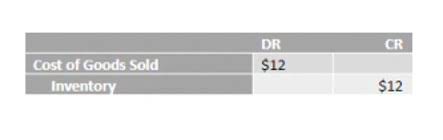
  • Typically, the entry involves debiting the COGS account to recognize the expense and crediting the inventory account to reduce the inventory value on hand.
  • This gives us the total cost of all inventory, but we can’t stop there.
  • Moreso, any unsold inventory at the end of the year is considered the ending inventory which is subtracted from the total of the beginning inventory and purchases to arrive at the COGS.
  • The factory overhead classification includes manufacturing and materials management salaries, as well as all utilities, rent, insurance, and other costs related to the production facility.

They may also include fixed costs, such as factory overhead, storage costs, and depending on the relevant accounting policies, sometimes depreciation expense. To calculate total COGS for your entire operation, you’ll need to add up all of your variable or ‘direct’ costs, which are costs that increase with each additional unit of output. It’s the cost of the inventory you had on hand at the beginning of the accounting period.

Sensitivity Analysis

By studying groups of smokers and nonsmokers, they established a link between smoking cigarettes and lung cancer. Sensitivity analysis is often used by scientists and engineers to check the validity of their research or calculations. For example, a company may perform NPV analysis using a discount rate of 6%. Though a company will have calculated its net present value, it may also want to understand how better or worse conditions will impact the numbers. It acts as an in-depth study that reveals potential hazards as well as the potential rewards to an undertaking.

Key Steps in Conducting Sensitivity Analysis

For example, a 3-variable parameter space which is explored one-at-a-time is equivalent to taking points along the x, y, and z axes of a cube centered at the origin. The proportion of input space which remains unexplored with an OAT approach grows superexponentially with the number of inputs. Sensitivity may then be measured by monitoring changes in the output, e.g. by partial derivatives or linear regression.

Understanding Sensitivity Analysis: Applications and Benefits

By following these best practices, you’ll gain deeper insights into your models and make more informed choices. Common methods include one-at-a-time (OAT), Latin hypercube sampling, and Monte Carlo simulations. Additionally, framing results in terms of risk management (e.g., “What-if” scenarios) helps decision-makers understand the practical implications. For example, ecological models may have tipping points related to biodiversity loss or climate change. These methods account for dependencies and provide a more accurate assessment of parameter importance.

Monte Carlo Simulation: Predicting Multiple Outcomes

  • Furthermore, one should ensure that the number of analyses presented is appropriate for illustrating how the model responds to these changes.
  • As one can see, removing the study with high RoB decreases the absolute risk difference of primary care follow-up by 8% (0.29 → 0.21).
  • Sensitivity analysis provides a range of possible outcomes, allowing informed decisions even when data are incomplete.
  • Have you ever wondered how slight changes in assumptions can affect the outcome of a financial decision?
  • However, it is important to recognize that sensitivity analysis has its limitations.
  • Local sensitivity analysis involves analyzing the effect of small changes in the input parameters on the model output.

Today, sensitivity analysis is widely used in various fields, including environmental modeling, financial risk analysis, and engineering design optimization. By analyzing the sensitivity of different parameters, organizations can identify which variables have the greatest impact on performance and focus their efforts on optimizing those areas. Furthermore, the increasing availability of big data and computational power will enable analysts to conduct more comprehensive sensitivity analyses, incorporating larger datasets and more variables. This technique provides a comprehensive view of how uncertainty in inputs can affect model outputs, making it a powerful tool for risk analysis and decision support. One common approach is local sensitivity analysis, which examines the effect of small changes in input variables around a nominal value. In the realm of data science, sensitivity analysis plays a pivotal role in model validation and decision-making.

Beyond Numbers: A Storytelling Tool

Focusing on matrix methods, this book delves into sensitivity analysis within the contexts of demography and ecology. This book provides a comprehensive introduction to sensitivity analysis, offering practical guidance on how to apply it to scientific models. Sensitivity Analysis is a technique used to evaluate how changes in input variables affect the outcomes of a process or system. As organizations increasingly rely on data-driven insights, the importance of sensitivity analysis in ensuring model reliability and robustness will only grow.

Study findings are considered robust if sensitivity analyses comparing the complete-case model and multiple imputation model yield similar results (Lee & Simpson, 2014). Imputation methods are commonly recommended over complete-case analysis when appropriate (e.g., data missing completely at random), given the reasons previously mentioned. Complete-case analysis excludes patients with missing data on one or more variables from statistical estimates (Little et al., 2012; Zhou, 2020). However, these post-hoc analyses require a clear rationale and justification outlined in the Methods section of the manuscript, including an explanation of the need for the sensitivity analysis (de Souza et al., 2016). Data screening, cleaning, and analysis, commonly reveal unanticipated barriers and findings, further highlighting the value of post-hoc sensitivity analyses (Morris et al., 2014).

  • Ignoring missing data in analyses can have implications on the reliability, validity and generalizability of research findings.
  • While this may not seem like an extreme difference in results, it does illustrate the value of using varying assumptions to hone in on an understanding of the stability of the associations under study with different analytical approaches, as in this example where point estimates varied by about +/- 10% depending in how the cohort was defined.
  • Understanding the nature of the data, and having some content expertise are useful in determining which and how many sensitivity analyses to perform.
  • To illustrate, imagine one is interested in conducting a systematic review with a meta-analysis aiming to pool data on the effect of enhanced discharge teaching for hospitalized older adults on follow-up with primary care.
  • Sensitivity analysis helps determine the optimal dosage by considering factors like bioavailability, metabolism rates, and side effects.
  • It’s especially useful in financial modeling, project planning, and forecasting to identify key factors influencing results.
  • Reassess the model periodically, especially when new data becomes available, to ensure that the findings are still relevant and accurate.

Financial Risk Analysis

The Morris method is useful for understanding the overall behavior of the model, including the interactions between variables and the non-linear effects of input parameters. The Morris method is a global sensitivity analysis technique that involves varying multiple input parameters simultaneously, using a randomized one-at-a-time design. Scenario planning is useful for understanding the potential outcomes of different decisions or events, and for identifying the most critical factors that affect the model output.

• A study compared the long-term effects of surgical versus non-surgical management of chronic back pain. A researcher might choose to explore differences in the characteristics of the participants who were included in the ITT versus the PP analyses. The results of the ITT analysis (on all 2336 participants who answered the follow-up survey) showed that the intervention had no significant effect. • A trial was designed to investigate the effects of an electronic screening and brief intervention to change risky drinking behaviour in university students. For trials with repeated measures, some protocol violations which lead to missing data can be dealt with alternatively. The PP analysis provides the ideal scenario in which all the participants comply, and is more likely to show an effect; whereas the ITT analysis provides a “real life” scenario, in which some participants do not comply.

By evaluating the impact of changes in variable inputs on the results of an optimization model, decision-makers can make informed decisions that lead to better outcomes. It is an essential tool that helps decision-makers identify the most critical variables that have the most significant impact on the model’s output. By using different methods of sensitivity analysis, we can gain valuable insights into the behavior of the optimization model and make better decisions.

Methods

Enterprise reporting transforms data into clear insights for smarter decisions. Reassess the model periodically, especially when new data becomes available, to ensure that the findings are still relevant and accurate. Overly optimistic or pessimistic inputs may lead to skewed results, affecting decision-making. It’s like a dance between the variables as one moves, the other responds. It gauges how a dependent variable reacts to the fluctuating values of independent variables.

This article aims to provide a comprehensive overview of sensitivity analysis, including its definition, importance, types, and applications. This primer offers a detailed exploration of global sensitivity analysis, providing insights into its application across various fields. Sensitivity Analysis is important because it helps organizations identify which variables have the most influence on their processes.

For example, in structural engineering, sensitivity analysis helps identify the critical parameters that affect the structural integrity of a building or bridge. From a financial perspective, sensitivity analysis is widely used in investment decision-making. By varying the input assumptions or criteria, we can assess the sensitivity of the overall risk assessment or decision-making process. It displays the magnitude of the impact of each input variable on the output, allowing decision-makers to prioritize their focus on the most influential factors. Sensitivity analysis is particularly valuable in financial modeling, risk management, and strategic planning, providing a clearer understanding of the degree of risk involved in decisions.

Establishing a time window that appropriately captures exposure during etiologically relevant time periods can present a challenge in study design when decisions need to be made in the presence of uncertainty.5 Uncertainty about the most appropriate way to define drug exposure can lead to questions about what would have happened if the exposure had been defined a different way. (Current users would reflect only people who could tolerate the treatment and, most likely, for whom treatment appeared to be effective).3 However, this “new user” approach can limit the questions that can be asked in a study, as excluding prevalent users might omit long-term users (which could overlook risks that arise over long periods of use). The robustness of an association to the presence of a confounder,1-2 can alter inferences that might be drawn from a study, which then might change how the study results are used to influence translation into clinical or policy decisionmaking.

It’s a tool that sharpens your decision-making skills. It’s crucial because it highlights both risks and opportunities. This analysis is not just about avoiding pitfalls; it’s about exploring new paths to success. It’s like having a roadmap when you’re lost in the wilderness of business decisions. It’s all about understanding how changes in key factors – like sales volume, costs, and other critical elements – sensitivity analysis definition impact profitability.

Financing Activities: Definition and Example

To accurately report cash flows, one must be familiar with T-accounts for retained earnings and dividends payable. It is important to note that the cash flow statement focuses on the payment of dividends, which affects the dividends payable account. It’s essential to differentiate between dividends declared and dividends paid, as only the latter affects cash flow. Key cash inflows include issuing bonds, obtaining loans, issuing equity, and selling treasury stock. (h) cash receipts from futures contracts, forward contracts, option contracts and swap contracts except when the contracts are held for dealing or trading purposes, or the receipts are classified as financing activities. (f) cash receipts from the repayment of advances and loans made to other parties (other than advances and loans of a financial institution);

Take the cash received from issuing equity and debt, subtract cash paid to repurchase equity and debt, and then subtract funds paid as dividends to calculate cash flow from financing activities. By analyzing these accounts, you can determine the actual cash outflow for dividends, which is essential for accurate financial reporting in the financing activities section of the cash flow statement. Subtract both the $149,000 of debt repaid and $50,000 of dividends paid to arrive at a (positive) cash flow from financing activities of $55,000. Furthermore, interest paid is also reflected in the statement of cash flows, specifically in the operating activities section, as it represents a cash outflow. With the cash flows from operating, investing, and financing activities established, we can compile a comprehensive cash flow statement that reflects the total change in cash during the period. In the financing activities section of the cash flow statement, the focus is on changes in long-term liabilities and equity.

When business takes on debt, it does so by taking a loan from the bank or issuing a bond. Because it’s easier for clients to pay invoices, accepting payments online means you can get paid up to 2x faster. Generally, cash receipts and cash payments are reported as gross rather than net. A company needs to manage its cash well to have money for expenses and expansion and to repay creditors and investors. More cash inflows than outflows also mean an increase in assets or equity.

Information about the specific components of historical operating cash flows is useful, in conjunction with other information, in forecasting future operating cash flows. Financing activity in a cash flow statement focuses on how a firm raises capital and pays it back to investors through capital markets. The treasury stock balance declined by $1 million in Covanta’s balance sheet, demonstrating the interplay of all major financial statements. Analyzing the cash flow statement is extremely valuable because it provides a reconciliation of the beginning and ending cash on the balance sheet.

Interest paid directly affects a company’s income statement and cash flow statement. Interest paid is an essential aspect of managing debt through operating activities. In the cash flow statement, only dividends paid are considered, as they represent the actual cash movement. These activities include cash inflows from issuing bonds, obtaining loans, issuing equity, and selling treasury stock. Unlike operating activities, which can be analyzed using the indirect or direct method, financing activities stand alone. (g) cash payments for futures contracts, forward contracts, option contracts and swap contracts except when the contracts are held for dealing or trading purposes, or the payments are classified as financing activities; and

This profile provides insights into the company’s ability to manage its debt obligations over time and highlights potential refinancing risks. The higher the ratio, the higher the proportion of debt in relation to equity, indicating a higher level of financial risk. By assessing various options and considering metrics like DSCR and cash flow adequacy, companies can make informed decisions to effectively manage their debt obligations. Companies must consider not only the current cash flow but also its sustainability over the long term. Refinancing involves replacing existing debt with new debt, often at more favorable terms.

Stockholder’s Equity

They’re recorded in a separate section — the operating activities — of the cash flow statement. Short-term liabilities related to financing activities include dividends payable, short-term loans, and the current payable how do you record adjustments for accrued revenue portion of long-term liabilities. A company’s financing activities affect the amount of short-term or long-term liabilities they report on the balance sheet.

For issued equity, earnings are shared with equity holders or stockholders through cash dividend payments. Examples of long-term obligations related to financing activities are bonds payable, long-term notes payable, and mortgage payable. Long-term liabilities refer to financial obligations that are not due within 12 months or the company’s operating cycle, whichever is longer.

Effective Debt Management in Action

It provides insights into a company’s ability to generate cash from its day-to-day operations. Engaging in open discussions with lenders, highlighting positive financial indicators, and comparing rates offered by different institutions can provide leverage in securing better terms. By combining multiple debts into a single loan with a potentially lower interest rate, borrowers can streamline their interest payments, making them more manageable. By ensuring that interest payments are made promptly, borrowers can avoid late fees and penalties, preventing unnecessary financial strain. When it comes to choosing the best debt management strategy, there is no one-size-fits-all solution. This strategy involves exchanging debt obligations for ownership in the company, typically through issuing shares to creditors.

  • For instance, some borrowers may choose to make monthly interest-only payments to alleviate immediate financial burdens while postponing principal repayment.
  • In other words, a short-term bank loan is a current liability.
  • Context is crucial when analyzing cash flow from financing activities.
  • Dividends paid and repurchase of common stock are uses of cash and proceeds from the issuance of debt are a source of cash.
  • Higher interest rates or a larger principal amount can result in higher interest payments.

(a) cash receipts from the sale of goods and the rendering of services; Therefore, they generally result from the transactions and other events that enter into the determination of profit or loss. This information may also be used to evaluate the relationships among those activities. It’s important to consider each of the various sections that contribute to the overall change in cash position.

  • By assessing various options and considering metrics like DSCR and cash flow adequacy, companies can make informed decisions to effectively manage their debt obligations.
  • By adopting a balanced approach, the company can achieve sustainable growth without compromising its financial stability.
  • These activities also include paying cash dividends, adding or changing loans, or issuing and selling more stock.
  • By focusing on paying down debt, a company can reduce its interest payments and improve its financial position.
  • This expense is incurred when a company borrows funds from external sources such as banks or issues bonds or other debt instruments.
  • This strategy involves transferring high-interest credit card balances to a new credit card with a lower interest rate, often with an introductory 0% APR period.

For many companies, finding the right balance between debt reduction and operational investments is the key to long-term success. By investing in operational improvements and optimizing processes, a company can increase its profitability and generate more cash flow. For example, a manufacturing company burdened with significant debt may choose to allocate a portion of its profits towards debt repayment instead of expanding operations. It is crucial to strike the right balance between debt and operations to optimize financial health and achieve sustainable growth. Debt and operations are two critical aspects of managing a business, and finding a balanced approach between the two is essential for long-term success. By adopting the most suitable strategy and staying committed to debt repayment, one can pave the way towards a healthier financial future.

The cash flow statement is one of the most important but often overlooked components of a firm’s financial statements. To learn more about how FreshBooks can help you manage your financing activities and overall business finances, contact us or start your free trial today. The activities that don’t have an impact on cash are known as non-cash financing activities. However, only activities that affect cash are reported in the cash flow statement. Both cash inflows and outflows from creditors and investors are considered financing activities.

By allocating a portion of their profits towards debt reduction, companies can improve their financial health, reduce interest expenses, and enhance their creditworthiness. However, it is essential to carefully evaluate the long-term impact of debt restructuring, as it may result in higher overall interest costs. This tax shield can free up additional funds that can average revenue per user be reinvested in the business or used to pay down debt faster. By negotiating better terms with lenders or taking advantage of favorable market conditions, companies can significantly lower their interest payments. On the income statement, interest paid is deducted from the revenue to calculate the net income.

How to calculate cash flow from financing activities

Conversely, many circumstances may cause a large negative cash flow from financing activities. Context is crucial when analyzing cash flow from financing activities. Financing activities, or the flow of cash to and from lenders and owners, provides insight into a company’s financial health and capital management. While debt can provide necessary capital for growth and expansion, it can also burden a company with interest payments and financial obligations.

Financing Activities

These transactions reflect how a company raises and uses funds from external sources to support its operations and growth. Retained earnings also saw a significant increase from \$48,000 to \$164,000, which suggests a combination of net income and dividends affecting this account. Notably, bonds payable increased from \$20,000 to \$130,000, indicating a cash inflow of \$110,000 due to the issuance of new bonds. An entity may hold securities and loans for dealing or trading purposes, in which case they are similar to inventory acquired specifically for resale. (b) cash receipts from royalties, fees, commissions and other revenue;

Debt consolidation loans or balance transfer credit cards can help streamline your debt repayment process and save on interest charges. Take stock of all your outstanding debts, including credit card balances, loans, and mortgages. This indicates that Company A generates sufficient cash flow to cover its debt service obligations, while Company B may face challenges in meeting its debt repayment requirements. This ratio provides a comprehensive measure of a company’s financial health by comparing its total debt to its shareholders’ equity. Understanding the importance of generating adequate cash flow from operations and prioritizing debt servicing is crucial for maintaining financial stability.

Explore our platform for other software products and business templates that can help you manage your business’s finances. This is done to provide an accurate picture of a company’s liquidity and its ability to pay current obligations as they come due. Skynova’s accounting software makes generating financial reports a breeze. It comes from transactions between the company and its investors and creditors.

What Are Some Examples of Financing Activities?

(b) cash receipts from sales of property, plant and equipment, intangibles and other long-term assets; These payments include those relating to capitalised development costs and self-constructed property, plant and equipment; (g) cash receipts and payments from contracts held for dealing or trading purposes. Creditors are interested in understanding a company’s track record of repaying debt as well as understanding how much debt the company has already taken on. An investor wants to closely analyze how much and how often a company raises capital and the sources of the capital. Dividends paid can be calculated by taking the beginning balance of retained earnings from the balance sheet, adding net income, and subtracting out the ending value of retained earnings on the balance sheet.

Yes, borrowing money on a short-term or long-term basis from the bank is considered a financing activity. Now and then, a company might also decide to repurchase previously issued shares of stock. Repayment of existing loans, the redemption of bonds, and the purchase of treasury stocks are all outflows related to paying off borrowed funds.

salvage value is treated as:

Publication 946 2024, How To Depreciate Property Internal Revenue Service

salvage value is treated as:

Things can get easier over time but some of these feelings may stay with you. Lots of men find it helpful to talk to someone about their feelings. This might be a friend or family member or someone who is trained to listen, like a counsellor or your doctor or nurse. You can also talk to our Specialist Nurses or someone who’s been there through our one-to-one support service or online community.

salvage value is treated as:

Salvage value and different depreciation methods

Note that by making this election, it does not change whether the basis is subject to salvage value is treated as: bonus depreciation, but rather only effects how the depreciation is calculated. First- and second-year depreciation for computer. The 200% DB rate for 5-year property is 0.40. You determine this by dividing 2.00 (200%) by 5 years. The depreciation for the computer for a full year is $2,000 ($5,000 × 0.40).

AccountingTools

salvage value is treated as:

A positive salvage value at the end of the asset’s life is treated as a negative cost. Note that capital costs explicitly exclude O&M costs. When we write any equation for cost, a negative cash flow becomes a positive cost. The company purchased the asset for a total basis of $51,000 and is projected to net $9,000 upon its eventual disposal, resulting in a total cost to the business of $42,000.

Recapture of Excess Depreciation

If you converted property held for personal use to use in a trade or business or for the production of income, treat the property as being placed in service on the conversion date. See Placed in Service under When Does Depreciation Begin and End? In chapter 1 for examples illustrating when property is placed in service. The election must be made separately by each person owning qualified property (for example, by the partnerships, by the S corporation, or for each member of a consolidated group by the common parent of the group). For information about how to determine the cost or other basis of property, see What Is the Basis of Your Depreciable Property?

Depreciation directly impacts salvage value. In the straight-line method, salvage value is deducted from the purchase price before dividing by useful life, ensuring depreciation is spread evenly. In declining balance depreciation, businesses often ignore salvage value until the end of an asset’s life.

  • You can deduct the full $2,900.
  • It equals total depreciation ($45,000) divided by useful life (15 years), or $3,000 per year.
  • 109–135, § 412(s), substituted “Such term shall not include” for “This paragraph shall not apply to”.
  • For Sankofa’s 2024 return, the depreciation allowance for the GAA is figured as follows.
  • If it starts to cause symptoms then you’re likely to be offered hormone therapy to control the cancer and help relieve symptoms.

salvage value is treated as:

(e)(7), (8). 115–97, § 13204(a)(1)(B), struck out pars. (7) and (8) which defined “qualified restaurant property” and “qualified retail improvement property”, respectively. 115–97, § 13204(a)(1)(B), (4)(B)(i), added par. (6) and struck out former par.

  • Special rules apply to vehicles acquired in a trade-in before 2018.
  • For provisions directing that if any amendments made by subtitle A or subtitle C of title XI §§ 1101–1147 and 1171–1177 or title XVIII §§ 1800–1899A of Pub.
  • Hence, a car with even a couple of miles driven on it tends to lose a significant percentage of its initial value the moment it becomes a “used” car.
  • (3) generally.

What Is the Basis for Depreciation?

This method depreciates the machine at its straight-line depreciation percentage times its remaining depreciable amount each year. In earlier years, an asset’s higher value leads to larger depreciation expenses, which decrease annually. Primary liver cancer is the sixth most diagnosed tumor and the third leading cause of cancer-related deaths worldwide, with hepatocellular carcinoma (HCC) accounting for 75-85% of primary liver cancers (1). For the past 10 years, we have witnessed an evolution of systemic therapies for hepatocellular carcinoma. In particular, immune checkpoint inhibitors (ICIs) and other immunotherapies are revolutionizing cancer management (2–4). Therefore, predicting the treatment response and survival benefit at an early stage is becoming increasingly important for ICIs treatment of HCC.

  • This information is sufficient to calculate each year’s depreciation.
  • (e)(7)(B).
  • They figured their MACRS depreciation deduction using the percentage tables.
  • Additionally, these patients showed prolonged PFS and OS.
  • 115–141, § 401(d)(1)(D)(iv), struck out “(other than a corporation which has an election in effect under section 936)” after “domestic corporation”.

But generally, salvage value is important because it’s the value a company puts on the books for that thing after it’s fully depreciated. It’s based on what the company thinks they can get if they sell that thing when it’s no longer useful. Sometimes, salvage value is just what the company believes it can get by selling broken or old parts of something that’s not working anymore. Salvage value, in simple terms, is the worth of an asset after its useful life. It is mainly used to compute the depreciation charge on the asset that affects an organisation’s profits and taxable gains. To rightfully estimate the gain/loss of a company, it is important to determine the salvage value correctly.

Compliance Calendar For The Month of December 2025

An election (or any specification made in the election) to take a section 179 deduction for 2024 can be revoked without IRS online bookkeeping approval by filing an amended return. The amended return must be filed within the time prescribed by law. The amended return must also include any resulting adjustments to taxable income. Once made, the revocation is irrevocable.

salvage value is treated as:

Adjustment of partnership’s basis in section 179 property. If you and your spouse elect to amend your separate returns by filing a joint return after the due date for filing your return, the dollar limit on the joint return is the lesser of the following amounts. To qualify for the section 179 deduction, your property must meet all the following requirements. If an amended return is allowed, you must file it by the later https://www.bookstime.com/ of the following. For fees and charges you cannot include in the basis of property, see Real Property in Pub. You make a $20,000 down payment on property and assume the seller’s mortgage of $120,000.

Return on Equity ROE Calculation and What It Means

The figure for capital in ROC is represented by the book value of the owner’s equity. ROI helps show a company’s return on investor money before the effects of any borrowing. On a company basis, a negative ROE may be caused by one-time factors such as restructurings that depress net income and produce net losses.

  • It represents the residual interest in the assets of an entity after deducting liabilities.
  • To enhance ROE, companies can adopt various strategies from different perspectives.
  • Because shareholders’ equity is equal to a company’s assets minus its debt, ROE is considered the return on net assets (as opposed to return on total assets).
  • Investors should utilize a combination of metrics to get a full understanding of a company’s financial health before investing.
  • A company’s management can use ROE internally to determine if they’re making good decisions that efficiently generate profits.
  • The next step involves looking at individual companies to compare their ROEs with the market as a whole and with companies within their industry.

Remember, these factors interact with each other, and their impact on ROE can vary across industries and companies. Effective strategic decision-making, strong leadership, and prudent capital allocation can contribute to higher ROE. Understanding these dynamics is crucial for assessing a company’s performance relative to its peers.

What Is the Average ROE for U.S. Stocks?

  • ROE is an extremely useful financial indicator, but it also has a number of disadvantages.
  • ROE is widely used by investors and analysts to assess a company’s profitability, efficiency, and financial health.
  • Equity was 10% ($100,000 divided by the average stockholders? equity of $1,000,000).
  • Return on equity (ROE) measures how well a company generates profits for its owners.
  • In reality, the long-term profitability or sustainability of an investment might take several years if not decades to become clear.

Employees receive equity-based compensation. In return, VCs receive equity stakes. High ROE indicates efficient utilization of equity. Preferred shareholders receive fixed dividends (usually at a specified rate) before common shareholders. The shareholder equity would be $400,000 ($1,000,000 – $600,000). By subtracting the expenses from the revenue, we find that the net income https://tax-tips.org/the-5-biggest-tax-credits-you-might-qualify-for/ for Company XYZ is $200,000.

Calculating Return on Equity

Investors examine ROE trends over time and against industry averages to identify well-run businesses. ROE shows which firms generate more profits per rupee invested within a sector. Since capital structure differs between sectors, investors use ROE to compare banks to banks, retailers to retailers, etc. ROE reveals how much profit a company produces from internal resources. Profit Margin measures how much net profit a company generates for each rupee of revenue. The article analyzes ROE from different perspectives to give readers a comprehensive understanding of this important financial ratio.

For non-financial stocks, ROE and ROCE tend to converge since non-financials use less debt financing. The high leverage amplifies returns to shareholders as measured by ROE. For banks, ROE will be much higher than ROCE since the former only measures returns against shareholder equity while the latter considers Equity plus debt.

Stay informed with Strike’s guide on in-depth stock market topic exploration. Comparing a stock’s ROE to its price-to-earnings (P/E) ratio is insightful. Asset turnover rate measures how efficiently assets are used to generate sales. A declining ROE could signal problems like declining sales, increasing expenses, poor inventory management, or the inability to control costs. ROE is also compared historically for the same company over time to spot trends.

Return on Equity vs. Return on Capital

The use of debt to buy back stock and thereby increase the return on equity can backfire. Another improvement option is to use more debt and less equity in a firm’s capital structure. The return on equity can be improved when a business buys back its own stock from investors; doing so reduces the amount in the denominator of the equation, thereby increasing the reporting return. To calculate the return on equity, simply divide net income by the total amount of equity. Understanding your business’s profitability for owners and investors is crucial. Both of them have a higher ratio of financial leverage.

Tips for Investors

High ROE due to excessive debt might be unsustainable. Efficiently deploying equity shows managerial prowess. We can infer that Company A is better at utilizing its equity. But if the market crashes, that leverage becomes a liability.

A good ROE ratio is between 15% and 20%; an excellent ROE is 40%. ROE vs return on assets (ROA) vs return on Invested Capital (ROIC) are different performance measurement metrics. Besides generating an ROE metric of 20.7%, which is the same as calculated in the basic ROE formula, the DuPont analysis calculation produces other valuable metrics. The second ROE calculation uses the expanded DuPont analysis formula.

Two companies with similar net incomes will show very different ROEs if one utilizes far more debt financing than the other. This increases the amount of Equity against which profits are compared even if overall net income does not rise proportionately. A high ROE in the stock market indicates that the company is generating substantial profits from relatively little shareholder investment. Thus, net income growth outpaces equity growth, increasing the ROE ratio. ROE varies significantly across industries, so the first step is comparing a company’s ROE to its industry peers. For growth-oriented companies, investors tend the 5 biggest tax credits you might qualify for to favor higher ROEs as this indicates earnings compound at a faster rate without requiring additional equity financing.

The average of stockholders’ equity is preferred over simply the ending balance of SHE. He has a vast knowledge in technical analysis, financial market education, product management, risk assessment, derivatives trading & market Research. This approach ensures that their investment choices are backed by a solid understanding of a company’s ability to sustain and possibly increase its dividend payouts.

It essentially indicates how effectively a company is using its shareholders’ equity to generate profits. Return on equity measures profitability using resources provided by investors and company earnings. While a higher ROE is generally better, investors should also look at the drivers of a company’s ROE to ascertain whether its profits are supported by sustainable factors. A higher ROE indicates a company is better at generating profits from its equity capital. At a high level, ROE shows how well a company’s management is able to generate returns for shareholders using the capital provided. The importance of ROE stems from the insight it provides into a company’s profitability and financial health.

Net income is typically reported on a company’s income statement. However, others prefer to dive into the financial performance of a company, known as fundamental investing. We do not manage client funds or hold custody of assets, we help users connect with relevant financial advisors.

Stocks with very high ROEs of over 40% are extremely efficient at generating income from shareholder capital. Comparing a stock’s ROE to its industry average or competitors helps determine if its valuation aligns with its earning power. For example, analysts compare the ROEs of Apple and Microsoft to see which tech giant generates higher returns from shareholders’ investments. However, an increasing ROE could mean management taking on greater financial risk rather than operating efficiency. So, investors should dig deeper to check if the rising ROE is due to smart leverage or just excessive borrowing.

For example, ROE can indicate the rate at which a company can grow without having to borrow additional money. As Johnson notes, “companies that are losing money on an accrual accounting basis may have a negative ROE but a positive cash flow.” For example, that doesn’t necessarily mean the company has a negative cash flow. That said, a high and stable ROE is generally better, but the absolute number should be considered in the context of the industry. Also, factors like company size and broader economic conditions can affect ROE, so that’s why it’s helpful to benchmark ROE against peers.

nonmanufacturing costs include

What are Non-Manufacturing Overhead Costs?

nonmanufacturing costs include

Cost of sales represented the highest cost on the income statement at $26,600,000,000. The second highest cost on the income statement—selling and general and administrative expenses—totaled $22,800,000,000. These expenses are period costs, meaning they must be assets = liabilities + equity expensed in the period in which they are incurred. Examples of marketing and selling costs include advertising costs, order taking costs and salaries of sales persons etc.

Nonmanufacturing Costs at PepsiCo

nonmanufacturing costs include

Controllable costs – refer to costs that can be influenced or controlled by the manager. Segment managers should be evaluated based on costs that they can control. Sunk costs – historical costs that will not make any difference in making a decision.

Direct labor:

Nonmanufacturing costs represent the necessary expenditures required to operate a business that do not directly involve the physical transformation of raw materials into a finished good. These costs are distinct from product costs, which include direct materials, direct labor, and manufacturing overhead applied in a factory setting. They form part of inventory and are charged against revenue, i.e. cost of sales, only when sold.

Terms compared staff

  • Indirect labor (part of manufacturing overhead) includes the production supervisors who oversee production for several different boats and product lines.
  • Even though nonmanufacturing overhead costs are not product costs according to GAAP, these expenses (along with product costs and profit) must be covered by the selling prices of a company’s products.
  • Now, add the value of existing inventory to the cost of purchasing new inventory to calculate the cost of direct materials.
  • Usually financial statements refer to the balance sheet, income statement, statement of comprehensive income, statement of cash flows, and statement of stockholders’ equity.

The next step is to calculate the costs of utilities (electricity, water, or gas) that are directly used in the manufacturing process (for example, fuel used to operate the production equipment). Table 2.3.1 provides several examples of manufacturing costs at Custom Furniture Company by category. The balance sheet reports information as of a date (a point in time). The income statement, statement of cash flows, statement of comprehensive income, and the statement of stockholders’ equity report information for a period of time (or time interval) such as a year, quarter, or month. Usually financial statements refer to the balance sheet, income statement, statement of comprehensive income, statement of cash flows, and statement of stockholders’ equity. Insurance Expense, Wages Expense, Advertising nonmanufacturing costs include Expense, Interest Expense are expenses matched with the period of time in the heading of the income statement.

Direct materials are raw materials that become an integral part of the finished goods. A primary component is sales compensation, which includes base salaries for sales management and variable commission structures for field representatives. Understanding this distinction is fundamental for accurate product pricing, financial reporting, and compliance with Generally Accepted Accounting Principles (GAAP). The overall health of a commercial entity relies heavily on efficiently managing these operational expenses, which support the entire value chain from executive oversight to final product delivery. Standard cost – predetermined cost based on some reasonable basis such as past experiences, budgeted amounts, industry standards, etc.

Production Costs: What They Are and How to Calculate Them

Examples of nonmanufacturing costs appear in Figure 1.5 “Examples of Nonmanufacturing Costs at Custom Furniture Company”. To help clarify which costs are included in these three categories, let’s look at a furniture company that specializes in building custom wood tables called Custom https://www.bookstime.com/ Furniture Company. Each table is unique and built to customer specifications for use in homes (coffee tables and dining room tables) and offices (boardroom and meeting room tables). The sales price of each table varies significantly, from $1,000 to more than $30,000. Costs that are not related to the production of goods are called nonmanufacturing costs23; they are also referred to as period costs24.

nonmanufacturing costs include

Examples include direct materials, direct labor, and sales commission based on sales. Indirect costs – those that cannot be traced to a particular object of costing. Indirect costs include factory overhead and operating costs that benefit more than one product, department, or branch. For instance, Ford Motor Company has reduced the price of F-150 Lightning, its electric car, by $10,000.

Optimize your workforce, take control of inefficiencies, and watch your profits soar with team time tracking software. That’s why you need a reliable partner to buddy up with and slash your costs. In case you’re spending too many resources on a task or project, the option to set budgets in Clockify will give you a detailed insight into how you can better balance those resources. To obtain these details, you can refer to the company’s employment records that has a list of all the employees and their hourly rates. If the net realizable value of the inventory is less than the actual cost of the inventory, it is often necessary to reduce the inventory amount.

nonmanufacturing costs include

These include selling expenses (such as advertising costs, delivery expense, salaries and commission of salesmen) and administrative expenses (such as salaries of executives and legal expenses). Manufacturing costs – incurred in the factory to convert raw materials into finished goods. It includes cost of raw materials used (direct materials), direct labor, and factory overhead. The key aspect of nonmanufacturing costs is their mandated accounting treatment as period costs. This designation contrasts with manufacturing costs, which are treated as product costs and are capitalized to the inventory asset account on the balance sheet. On the other hand, a product with a low gross profit may actually be very profitable, if it uses only a minimal amount of administrative and selling expense.

multi step income statement example

Multi Step Income Statement: A Practical Guide for Financial ..

multi step income statement example

Revenue is all income generated by the sale of the business’ primary goods or services. Revenue may also be referred to as the “top line,” because it is the first line on the income statement. Accurate accounting ledgers and records of expenses, revenues, and credits are required for tax purposes and can help keep you in compliance with tax regulations. They use competitors’ P&L to gauge how well other companies are doing in their space and whether or multi step income statement not they should enter new markets and try to compete with other companies. Internal users like company management and the board of directors use this statement to analyze the business as a whole and make decisions on how it is run. For example, they use performance numbers to gauge whether they should open new branch, close a department, or increase production of a product.

Ways to Use ChatGPT for Accounting Automation and Efficiency

A multi step income statement includes subtotals for gross profit, operating expenses, and non-operating expenses. A single step income statement lists line items for revenues and costs and expenses with no subtotals, reaching a total for net income (loss) as the bottom line. In a multi step income statement,  business activities are separated into operating activities and non-operating activities. Non-operating items, including non-operating revenues, non-operating expenses, and non-operating gains (losses), are shown separately from operating revenues and operating expenses. With this separation in financial reporting, you can analyze ongoing business operations separately from non-operating items.

Income statement: Definition, preparation, and examples

It separates operating Travel Agency Accounting activities (the core business stuff) from non-operating ones (like interest or one-time gains). Think of it as peeling an onion – each layer reveals more about profitability. Multi-step income statement format is any day better than a single-step statement as it provides proper detailing. The company’s management might shift the expenses from the cost of goods sold to the operations to improve their margins artificially. It is very significant to view the comparative financial statements over time so that one can see and judge the trends and then possibly catch the misleading placement of the expenditures.

  • Some of the common expenses recorded in the income statement include equipment depreciation, employee wages, and supplier payments.
  • A multi-step income statement is more detailed than a single-step income statement.
  • Simply put, this is the money a business or company earns by offering services or goods.
  • This means that CBS has a margin of 39% to cover operating expenses and profit.
  • Income statements, also called profit and loss statements, are one of the major financial statements prepared by businesses.
  • For a retail store, this is the total value of goods sold; for a service provider, it’s the total fees earned from services rendered.
  • The Board of Directors will receive a financial statement package, including the (multi-step) income statement, that includes analysis and interpretations of trends by the financial analyst team and the company’s CFO.

Format and Example

multi step income statement example

Here you can find example Income Statement which is provided in a multiple step format. how is sales tax calculated Next, we calculate the cost of goods sold (COGS), which represents the direct costs attributable to the production of the goods sold by the company. IDC MarketScape vendor analysis model is designed to provide an overview of the competitive fitness of technology and suppliers in a given market.

multi step income statement example

Operating expenses in a multi-step income statement are the costs necessary to run the business that are not directly tied to the production of goods or services. Examples include payroll for employees, rent, utilities, advertising, and general administrative expenses. These expenses are deducted from gross profit to determine income from operations, which reflects the profitability of the company’s core business activities. Investors and lenders can use a multi-step income statement to analyze how effectively a company’s core business activities are performing.

multi step income statement example

Financial Statements

  • When calculating gross profit, no other expenditures are included apart from the cash inflow from the sale of goods and cash outflow from the purchase of goods.
  • A simple multiple step income statement separates income, expenses, gains, and losses into two meaningful sub-categories called operating and non-operating.
  • The purpose of an income statement is to show the profits and losses a company made over a specified period of time.
  • The multi-step income statement is a method of presenting the financial results of a company by segmenting the revenue, costs, and expenses into distinct sections.
  • The multi-step income statement details the gains or losses of a business, in a specific reporting period.
  • The research methodology utilizes a rigorous scoring methodology based on both qualitative and quantitative criteria that results in a single graphical illustration of each supplier’s position within a given market.
  • Upon completion, earn a recognized certificate to enhance your career prospects in finance and investment.

These take minimal time to prepare and don’t differentiate operating versus non-operating costs. Moving down, Operating Income (Gross Profit – Operating Expenses) reveals how profitable your core business operations are. This figure excludes non-operating activities like interest or gains/losses from asset sales, providing a clean picture of your efficiency in managing everyday business functions like administration, sales, and marketing.

mark to market

Mark to Market: Understanding the Importance of Real-Time Asset Valuation

mark to market

Mark to market (MTM) or fair value accounting refers to the practice of assigning a value to an asset or liability based on its current market value or price rather than its historical cost. This aims mark to market accounting to represent a realistic present-day valuation as compared to historical cost accounting. In boom times, mark to market accounting could artificially inflate balance sheets. That could lead businesses to take on more risk than they should, given the backstop of their inflated assets. We saw that play out in 2008 as mortgage-backed securities increased in value, leading to looser lending decisions from banks.

mark to market

Mark-to-Market Accounting in India

This mechanism ensures that positions are properly collateralized, preventing a trader’s losses from affecting the broader market. If that stock is trading at $75 per share today, MTM requires you to update the value of that asset on your balance sheet from the purchase price ($5,000) to its current market value ($7,500). The $2,500 difference is recorded as an unrealized gain on your income statement, even though you haven’t sold the stock. The concept originated in futures markets, where traders and brokerages needed to adjust their margin accounts daily. MTM later became a cornerstone of corporate accounting standards, particularly after the FASB formalized guidelines. This standardization helps protect QuickBooks investors and regulators from misleading financial statements by requiring assets to be valued at the price they would fetch in an orderly market transaction.

Examples of drawbacks in mark to market accounting

This section of the course is covered by tree canopy and there are now signs of Lincoln fast approaching. Runners may start to notice an increased number of birds in this section especially when they pass the Audubon Grassland Prairie area before 100th Street. Runners will pass a small country estate as they run over A Street at about 98th Street. Continuing down the crushed limestone trail, runners pass YMCA’s Sprit Park before reaching the MoPac Station Trailhead on the outskirts of Lincoln. Use caution when crossing 148th Street, the road is paved and the trail is difficult for drivers to see.

mark to market

Real-World Applications of MTM Accounting

mark to market

The quantum of loss is deducted from the client’s margin account balance, and the balance payment is made out. Mark to market ensures balance-sheet relevance for market-facing firms while creating demands for valuation governance and data integrity. The method is especially pivotal for futures where daily settlement enforces real-time credit discipline. Mutual Fund investments are subject to market risks, read all scheme related documents carefully.This document should not be treated as endorsement of the views/opinions or as investment advice.

  • Ultimately, better risk management leads to more liquidity and lower borrowing costs within the financial system.
  • Mark to market introduces several concrete risks that must be managed through governance, capital planning and disclosure.
  • Our team of experts specializes in providing tailored solutions to help businesses navigate complex financial landscapes.
  • Before trading, clients must read the relevant risk disclosure statements on IBKR’s Warnings and Disclosures page.
  • Criminal investigations ensued when it was discovered that accounting firms were literally shredding financial statements to conceal them from the SEC.
  • But for assets with a lower degree of liquidity, such as inventory, business equipment, or real estate, obtaining the current value of the asset can be more difficult and require the services of an appraiser.

Depreciation is always calculated based on historical cost whereas impairments are always calculated on mark-to-market. Physical assets are more often recorded at historical cost whereas marketable bookkeeping and payroll services securities are recorded at mark-to-market. Securities or other financial instruments mentioned in the material posted are not suitable for all investors. Before making any investment or trade, you should consider whether it is suitable for your particular circumstances and, as necessary, seek professional advice.

mark to market

best accounting firm for startups

A Comprehensive Guide TRUiC

best accounting firm for startups

Their strong emphasis on supporting startups and small enterprises makes them a valuable partner for business owners seeking growth support. DualEntry develops AI-based accounting software to handle complex transactions for mid-market enterprises. Their platform automates core bookkeeping tasks, aiming to reduce manual errors and Streamline Your Finances with Expert Accounting Services For Startups improve the accuracy of financial reporting. AppZen builds an AI-powered platform that automates financial operations for enterprise finance teams. The company’s technology is used to audit expenses and invoices, helping businesses reduce spend and enforce compliance. Bookkeepers handle day-to-day transactions, while CPAs offer strategic advice, tax optimization, and compliance expertise.

best accounting firm for startups

Breaking Down Accounting Firm Pricing Models

best accounting firm for startups

Let’s explore the key challenges that often hinder startup finance teams and how modern accounting solutions can address them. Mowery & Schoenfeld is recognized as a top CPA firm in Illinois, serving the Chicago area with a range of comprehensive accounting services. Their unique approach combines deep financial expertise with a personalized client experience.

best accounting firm for startups

List of accounting firms alternative to Bench

Nowadays, many accounting firms use tax software to structure the accounts process. Furthermore, you will also get guidance on developing budgets and setting financial goals for your business. Bookkeeping entails keeping track of all financial documents and transactions relevant to your startup. This may include receipts, tax forms and returns, bank and credit card statements, https://dimensionzen.com/streamline-your-finances-with-expert-accounting-services-for-startups/ and proof of payments. You can do bookkeeping manually or use software like QuickBooks to help you manage and track your startup’s financial documents.

  • When your financials are consistently organized, you can confidently maximize deductions and maintain compliance, which ultimately helps you keep more of your hard-earned money.
  • We handle income tax preparation along with state and local taxes (SALT).
  • Choosing the right firm, as highlighted by Kruze Consulting, is a crucial decision for any startup seeking to scale.
  • Situated in the bustling heart of San Francisco, our accounting firm is a vital asset for startups seeking top-tier financial expertise ‘near me’.
  • Startups often have issues maintaining accurate financial records, managing tax obligations and compliance, and setting up financial operations.
  • Conveniently located in Chicago, they are well-positioned to serve a diverse client base with tailored financial solutions.

Specialized Support for Venture-Backed Companies

Picking the right business structure is one of the first major decisions you’ll make as a founder, and it has long-lasting effects on your taxes, personal liability, and ability to raise money. You’ll typically choose between a sole proprietorship, a partnership, a limited liability company (LLC), or a corporation (like an S-Corp or C-Corp). For instance, an LLC or a corporation creates a legal wall between your personal assets and your business debts, which is a huge relief for many entrepreneurs. This separation is crucial for protecting your personal finances if the business faces legal challenges or financial trouble. Book consultations with your top candidates before making the final call.

Cash Flow Management for Sustainable Growth

best accounting firm for startups

These tools help identify potential monthly cost savings of up to $2,000. The team handles tax compliance throughout the year for startup founders who feel overwhelmed by financial management. They also provide cash flow modeling tools that help companies evaluate if they can afford new hires before making commitments.